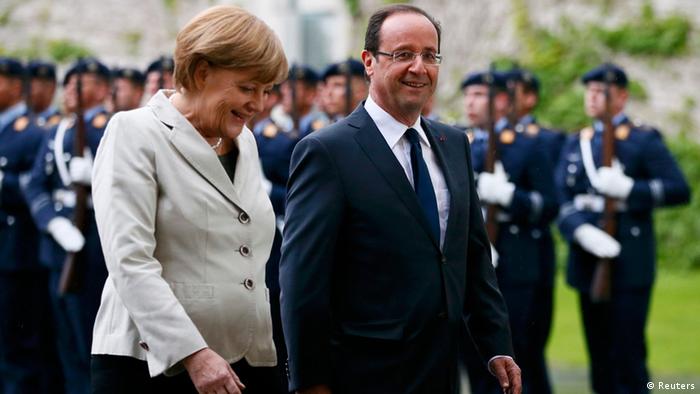
New French President Francois Hollande visited Germany this past week (an hour late for his meeting due to a lightning strike on the presidential plane), with messages of encouragement for Germany and France to cooperate on current EU issues. Both leaders remarked that having the two nations work together would be beneficial for current issues, especially in the economy. Growth is encouraged by both nations as a possible antidote to the crisis, but both leaders agreed to "moot" proposals in the next few weeks that "bolster" economic growth. Hollande said that he was "for budget seriousness" as well as growth. Regarding Greece, both leaders wish for the nation to remain in the Eurozone. However, the two leaders have very different views on how to handle crises such as those that have confronted Merkel and Hollande recently.
While Angela Merkel remains adamant that austerity measures will be beneficial in restoring economic order, Hollande encourages stimulus packages, a view that was discussed in his inaugural speech. These differences may be soothed, however, with the appointment of France's new Prime Minister, "Germanophile" Jean-Marc Ayrault.
http://www.dw.de/dw/article/0,,15953154,00.html
26.5.12
Current Event 5/26/12
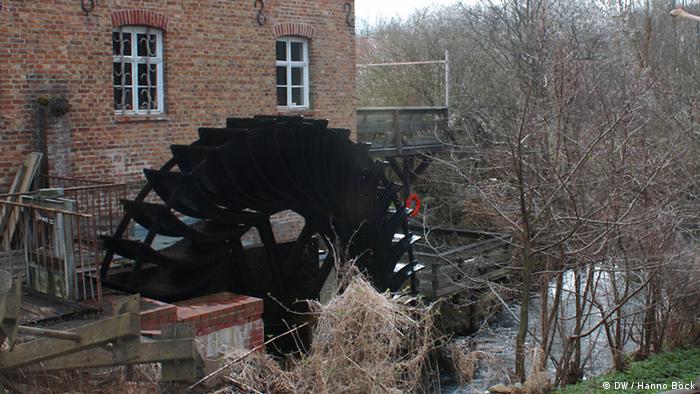
Near Berlin, nineteenth-century water mills are being reused, to produce clean energy. The mills have stood unused for long periods of time, but are now being reworked as part of the green energy revolution. The Gollmitzer mill, north of Berlin, is one example. Kai Rogozinski, a heating engineer, was fascinated by the mill and the "power of the water." Using the Zuppinger wheel design, Rogozinski built a wheel that looks old and idyllic, but actually generates electricity via a concealed generator. 90,000 ilowatts of electricity were generated last year, with 65,000 of that going to the German electricity grid. Hydropower tariffs are priced lower than solar power tariffs, and so Rogozinski uses a lot of the energy he produces himself. He says that financial support was essential to allowing him to build the mill. In addition to producing hydropower, it is also hoped that the mill can be used to produce flour.
The green movement is very present in Germany, from recycling to alternative energy. The new situation of mills encourages this movement, and will be a positive thing for both the German job market and the environment, as well as preserving Germany's unique landscape and history.
http://www.dw.de/dw/article/0,,15952439,00.html
The green movement is very present in Germany, from recycling to alternative energy. The new situation of mills encourages this movement, and will be a positive thing for both the German job market and the environment, as well as preserving Germany's unique landscape and history.
http://www.dw.de/dw/article/0,,15952439,00.html
14.5.12
Holy Heidenheim!
After a very exhausting weekend, "Inbox (1)" was not a very unusual thing to see once I finally sat down to check my email last night.
However, it soon became the best part of my day, when I realized that the email was from a German Rotarian from the small city of Heidenheim, in the south of Germany, to tell me that I would be an exchange student in Heidenheim an der Brenz, to use its full name, which is in Rotary District 1830.
This is where I will be living next year!!!!!!!!
I was informed that there are about 50,000 people in Heidenheim, which is part of Baden-Wurttemberg. It is several hours' drive from Munich, Ulm and Stuttgart.
It's so fantastic to actually have a place to think about! I have been looking at pictures and hope to hear soon about my school and host family.
To read more about the city, click here for the city website, or here for general information.
Here are some of the fruits of my frantic, ecstatic Googling:
However, it soon became the best part of my day, when I realized that the email was from a German Rotarian from the small city of Heidenheim, in the south of Germany, to tell me that I would be an exchange student in Heidenheim an der Brenz, to use its full name, which is in Rotary District 1830.
This is where I will be living next year!!!!!!!!
I was informed that there are about 50,000 people in Heidenheim, which is part of Baden-Wurttemberg. It is several hours' drive from Munich, Ulm and Stuttgart.
It's so fantastic to actually have a place to think about! I have been looking at pictures and hope to hear soon about my school and host family.
To read more about the city, click here for the city website, or here for general information.
Here are some of the fruits of my frantic, ecstatic Googling:
Yes, I will be living in a town with a castle.
12.5.12
Current Event 5/12/12
The Pirate Party, which has been rising to increasing domination all over the country, is predicted to be victorious again during the North Rhine-Westphalia parliamentary elections this weekend. The popularity of the party is also growing, due to other recent victories. Angela Merkel said, "We are taking the Pirates seriously."
Many appreciate the Pirates' attempts at transparency in government and the freshness it brings to the political scene, and supporters are not longer just young "computer nerds," but older people as well. However, some are skeptical that the Pirates may not be able to present feasible policies.
Areas that the Pirates hope to change include education, public transportation and welfare improvements, but the finalization of budgets has proved to be difficult, questioning the Pirates' effectiveness as a reform movement.
The presence of a new and growing political party in Germany could undermine current political power and possibly alter political stability. Unless the Pirates pull a radical act and their support increases dramatically, the threat to the current system will remain small. However, a decrease in support for mainstream political parties could jeopardize policies and missions that are important to increasing stability in the economies and social situations of nations in the EU.
http://www.dw.de/dw/article/0,,15944495,00.html
Many appreciate the Pirates' attempts at transparency in government and the freshness it brings to the political scene, and supporters are not longer just young "computer nerds," but older people as well. However, some are skeptical that the Pirates may not be able to present feasible policies.
Areas that the Pirates hope to change include education, public transportation and welfare improvements, but the finalization of budgets has proved to be difficult, questioning the Pirates' effectiveness as a reform movement.
The presence of a new and growing political party in Germany could undermine current political power and possibly alter political stability. Unless the Pirates pull a radical act and their support increases dramatically, the threat to the current system will remain small. However, a decrease in support for mainstream political parties could jeopardize policies and missions that are important to increasing stability in the economies and social situations of nations in the EU.
http://www.dw.de/dw/article/0,,15944495,00.html
5.5.12
Current Event 5/5/12
Berlin, while being a vibrant tourist destination as well as a center of culture, attracts many students from all over the globe. However, in addition to diverse cultural exposure, students in Berlin get a good education: Berlin has ranked 8th out of 98 cities all over the world as a top city for students.
For students, Berlin is relatively inexpensive, with rent and other prices low compared to other EU countries. The diversity of both culture and educational opportunities makes it a fun and exciting place to be, and the increasing internationalization makes it an optimal city for students.
However, Berlin is not all fun and games. Some students say that it is hard to make friends as a foreigner, while others remark on the fact that Berlin is a poor city and facilities are run-down. Many continue to say that the "liberal atmosphere" of Berlin makes it a wonderful place to be a student, but the harsh reality of the job market makes it a harder place to live once students graduate.
Olaf Reupke, a coordinator for international students at the Technical University, says that the competitiveness of the German job market eventually causes most students to leave. Because of Berlin's high unemployment rate, students are not expected to receive jobs, and although some remain as interns, most leave the city to pursue opportunities elsewhere.
Berlin's role as a capital means that if it is attractive to students and other foreigners, it will be more prosperous. However, of-the-moment culture will not entice people to stay for long if they do not have jobs. The German job market must be enlarged in order to draw new, younger people to live in the city, expand the economy, and continue to allow culture to flourish.
http://www.dw.de/dw/article/0,,15921795,00.html
For students, Berlin is relatively inexpensive, with rent and other prices low compared to other EU countries. The diversity of both culture and educational opportunities makes it a fun and exciting place to be, and the increasing internationalization makes it an optimal city for students.
However, Berlin is not all fun and games. Some students say that it is hard to make friends as a foreigner, while others remark on the fact that Berlin is a poor city and facilities are run-down. Many continue to say that the "liberal atmosphere" of Berlin makes it a wonderful place to be a student, but the harsh reality of the job market makes it a harder place to live once students graduate.
Olaf Reupke, a coordinator for international students at the Technical University, says that the competitiveness of the German job market eventually causes most students to leave. Because of Berlin's high unemployment rate, students are not expected to receive jobs, and although some remain as interns, most leave the city to pursue opportunities elsewhere.
Berlin's role as a capital means that if it is attractive to students and other foreigners, it will be more prosperous. However, of-the-moment culture will not entice people to stay for long if they do not have jobs. The German job market must be enlarged in order to draw new, younger people to live in the city, expand the economy, and continue to allow culture to flourish.
http://www.dw.de/dw/article/0,,15921795,00.html
27.4.12
Current Event 4/28/12
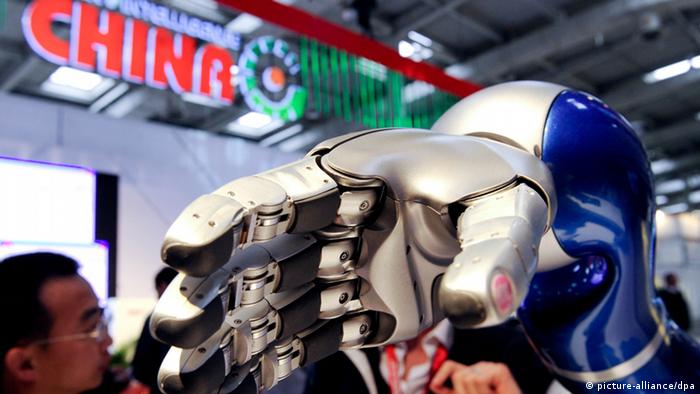
The Hanover Trade Fair this year will see some of the world's finest in trade and industry come together to see the situation of global finance and progress. At the forefront of progress are Germany and China, although the two nations are doing very different things. Because China is Germany's biggest export nation, positive relations between the countries are a priority. Germany also supplies China with machines and technology that are essential to China's continued growth. This growth, however, has caused China to begin producing its own machines--something that could narrow Germany's edge on the Chinese markets. The Trade Fair is an opportunity for Germany to see if China's machinery can compete with German products, and although German companies have respect for Chinese industry, windmill producer Joachim Fuhrlander says they are not afraid. He says partnership and sharing are not going to break the bank for German companies.
Other German machinery on display at the Fair includes hydropower and power-amplifying robot hands for tricky and risky jobs.
The global economic presence of Germany is evidenced by their confidence and willingness to trade with China. Germany's strong industrial market's unwillingness to be fazed by "new talent" further demonstrates this confidence, and with confidence comes the assurance that the German economy is growing and changing while remaining stable and secure.
http://www.dw.de/dw/article/0,,15904520,00.html
Other German machinery on display at the Fair includes hydropower and power-amplifying robot hands for tricky and risky jobs.
The global economic presence of Germany is evidenced by their confidence and willingness to trade with China. Germany's strong industrial market's unwillingness to be fazed by "new talent" further demonstrates this confidence, and with confidence comes the assurance that the German economy is growing and changing while remaining stable and secure.
http://www.dw.de/dw/article/0,,15904520,00.html
13.4.12
Current Event 4/21/12
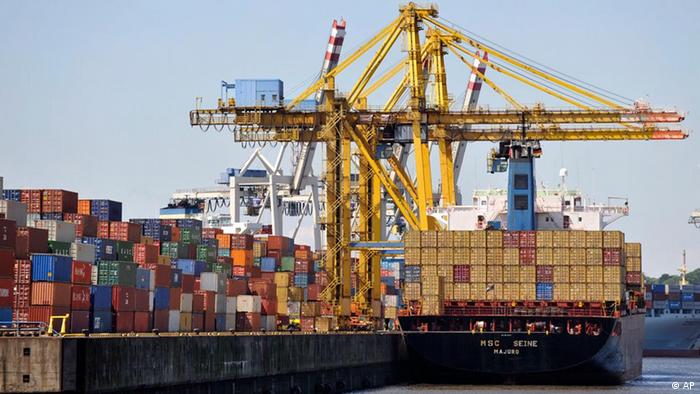
Germany, the EU's biggest and most powerful economy and the fourth-largest economy in the world, has experienced difficulties lately with the international recession and the EU debt crisis. However, recent data shows that the economy is changing--for the better. Although Germany's status as the largest exporter of goods in the world has changed because of the success of the US and China, the growth of Asian economies also benefits Germany. There is a very large market for German-manufactured goods in countries such as China. Anton Börner, the president of the German Foreign Trade Association, thinks that at the current economic rates, Asian and European markets for German goods will be roughly the same by about 2040. The Federal Statistics Office reports that exports are up 8.6%, and worth about 91.3 billion euros. In Europe, German exports have dropped six points, to only 59% percent in EU countries. The figures in Italy and Greece are even lower.
But the German economy will also benefit from services provided, says Börner. Engineering is currently big, with health and care services also projected to grow.
The loss of market for German goods in Europe reflects the current situation of the EU, which is unstable and unwilling to take large economic risks such as investing in a market for German goods. However, the global economic situation virtually nullifies the European economic weakness and disinterest in German goods. Rising standards of living and economic stability in Asian countries like China mean that Germany has a promising economic future if China continues to grow. This is a positive thing for Germany, and means that the powerful nation can continue its projects of growth and development, while helping out the EU in its crisis, without too much fear of losing its market for goods produced in Germany.
http://www.dw.de/dw/article/0,,15869427,00.html
But the German economy will also benefit from services provided, says Börner. Engineering is currently big, with health and care services also projected to grow.
The loss of market for German goods in Europe reflects the current situation of the EU, which is unstable and unwilling to take large economic risks such as investing in a market for German goods. However, the global economic situation virtually nullifies the European economic weakness and disinterest in German goods. Rising standards of living and economic stability in Asian countries like China mean that Germany has a promising economic future if China continues to grow. This is a positive thing for Germany, and means that the powerful nation can continue its projects of growth and development, while helping out the EU in its crisis, without too much fear of losing its market for goods produced in Germany.
http://www.dw.de/dw/article/0,,15869427,00.html
Subscribe to:
Posts (Atom)